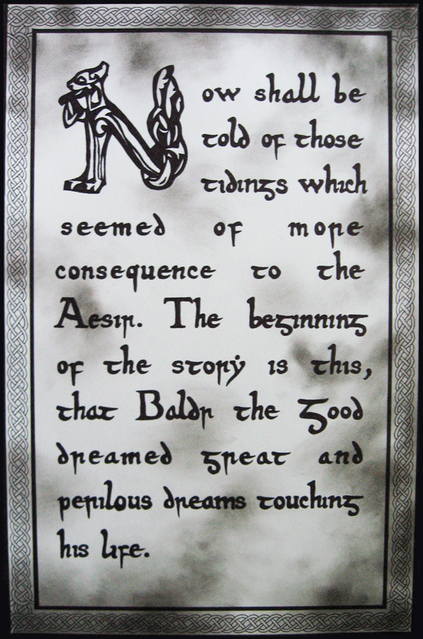
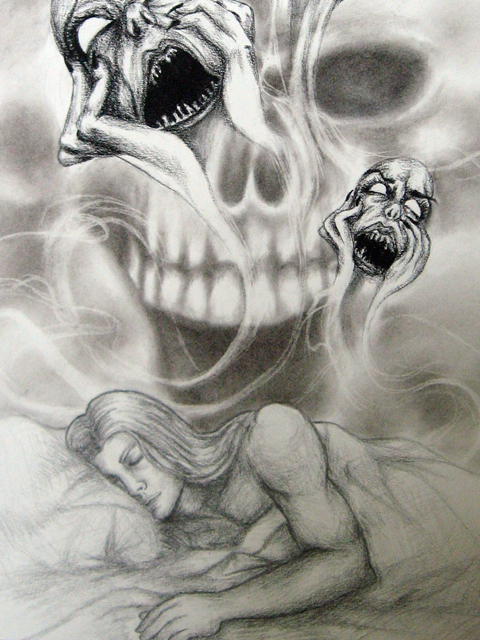
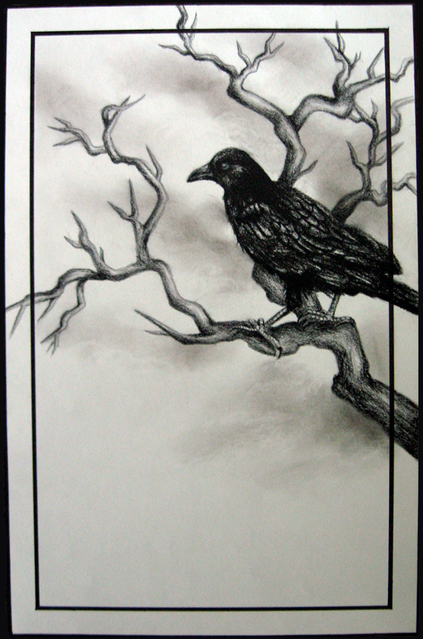
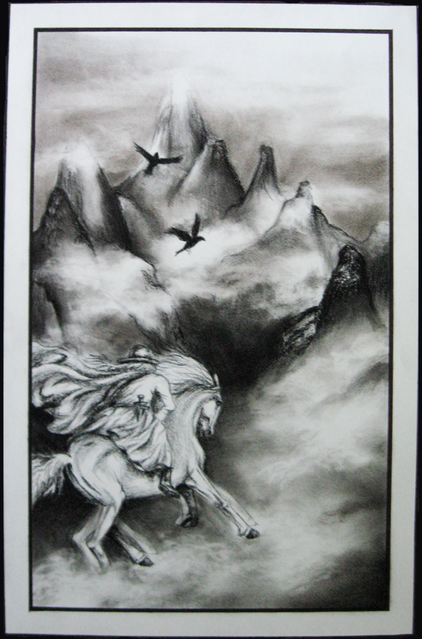
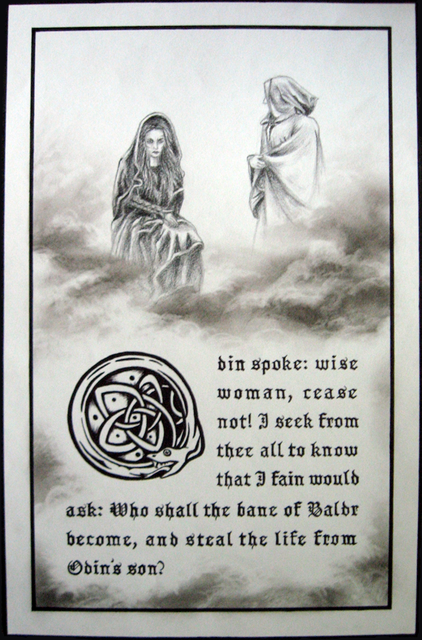
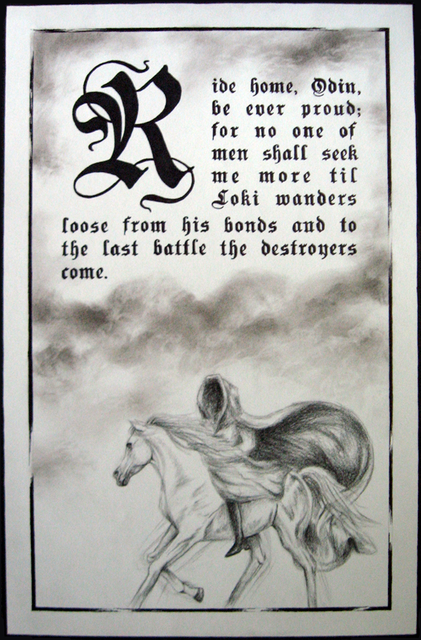
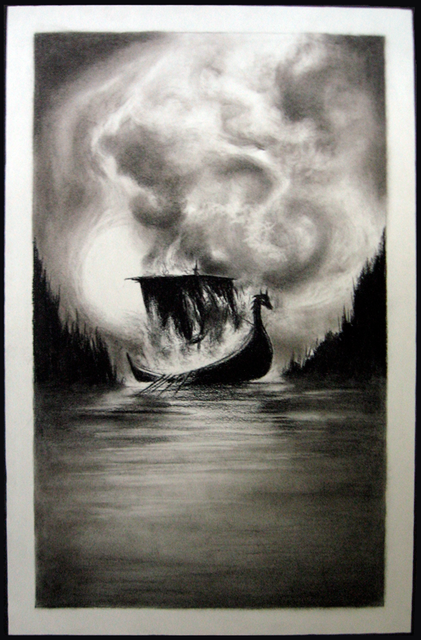
Advanced Drawing Strategies: 19.5" x 12.75" charcoal, graphic, and ink drawings on Stonehenge paper. Please note that the outer border is the same width as the inner border. It was impossible to photograph the drawings perfectly straight. Also, the figures of Odin and Sleipnir riding into Hel are appropriated from John Howe's of Gandalf and Shadowfax as they ride to Minas Tirith. I am making no profit on these drawings nor do I claim the figures as my own.
Artist Statement:
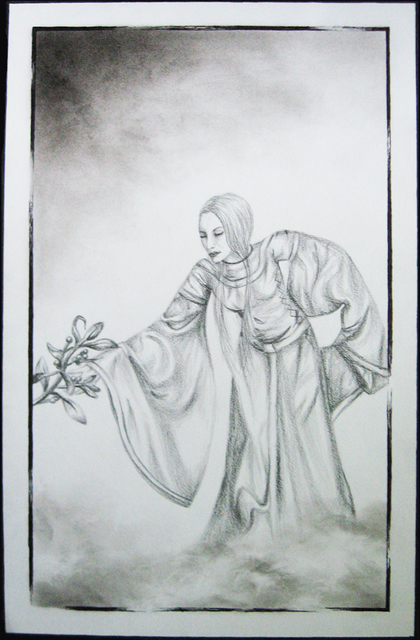
For my series, I am using passages from the Prose and Poetic Eddas that chronicle the passing of the Norse god of light, beauty, and happiness: Baldr. The Eddas are the main sources of Germanic mythology and skaldic tradition, which were recorded during the 11th Century A.D. by Snorri Sturluson as Northern Europe underwent Christianization. Baldr’s death ultimately sets off the series of events that lead up to Ragnarök, a great battle where most of the gods and all but two humans will perish. Through Baldr’s death, the gods discover a traitor among them and are reminded that even they cannot escape death or fate.
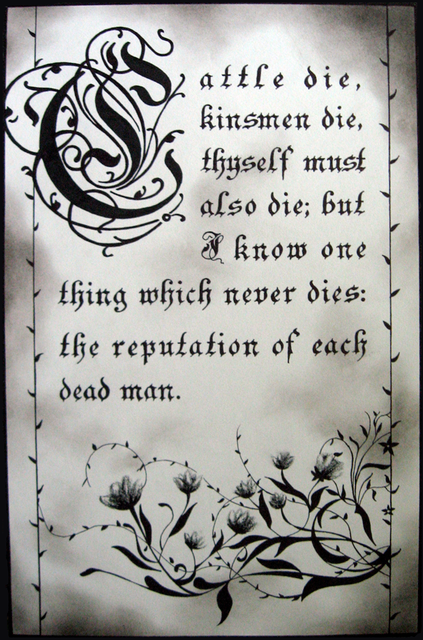
I am portraying the concept of death and the afterlife in this series from a pagan perspective while showing my personal interpretation of the mythology that inspired much of today’s fantasy genre. The figures are represented naturalistically, drawing inspiration from 20th Century illustrations, while keeping their accurate Viking Age appearances described in the Eddas. Charcoal, graphite, and ink are the materials used throughout the entire series, as the absence of color reflects the serious tone of the story in addition to Europe’s Dark Ages. I am also celebrating the narrative tradition by weaving text from this story into the series that is reminiscent of the stylized manuscripts from Medieval Northern Europe. The series begins with text taken from the original Beowulf manuscript and ends with a detailed floral illustrated Gothic manuscript. The progression of time is depicted through the evolution of typography in the series, just as the gods’ fates unfold as time takes its course.
I am portraying the concept of death and the afterlife in this series from a pagan perspective while showing my personal interpretation of the mythology that inspired much of today’s fantasy genre. The figures are represented naturalistically, drawing inspiration from 20th Century illustrations, while keeping their accurate Viking Age appearances described in the Eddas. Charcoal, graphite, and ink are the materials used throughout the entire series, as the absence of color reflects the serious tone of the story in addition to Europe’s Dark Ages. I am also celebrating the narrative tradition by weaving text from this story into the series that is reminiscent of the stylized manuscripts from Medieval Northern Europe. The series begins with text taken from the original Beowulf manuscript and ends with a detailed floral illustrated Gothic manuscript. The progression of time is depicted through the evolution of typography in the series, just as the gods’ fates unfold as time takes its course.


No comments:
Post a Comment